Beyond the Degree: 8 Essential Real-World Skills Every College Student Needs for 2026
For many high school seniors and incoming freshmen in the USA, the definition of “higher education” is often limited to lecture halls, midterms, and the pursuit of a degree. While academic rigor is the foundation of the university experience, the true value of college in 2026 lies in the “unseen curriculum.”
Beyond the textbooks and laboratory reports, the collegiate environment serves as a high-stakes laboratory for personal and professional development. It is a transitional space where students navigate complex social hierarchies, manage finite resources, and solve problems that don’t have a clear marking rubric. To truly succeed, students must look toward career readiness skills that go beyond subject matter expertise. Utilizing a professional essay editing service can help bridge this gap, allowing students to focus on these high-level soft skills while ensuring their written work meets elite academic standards.
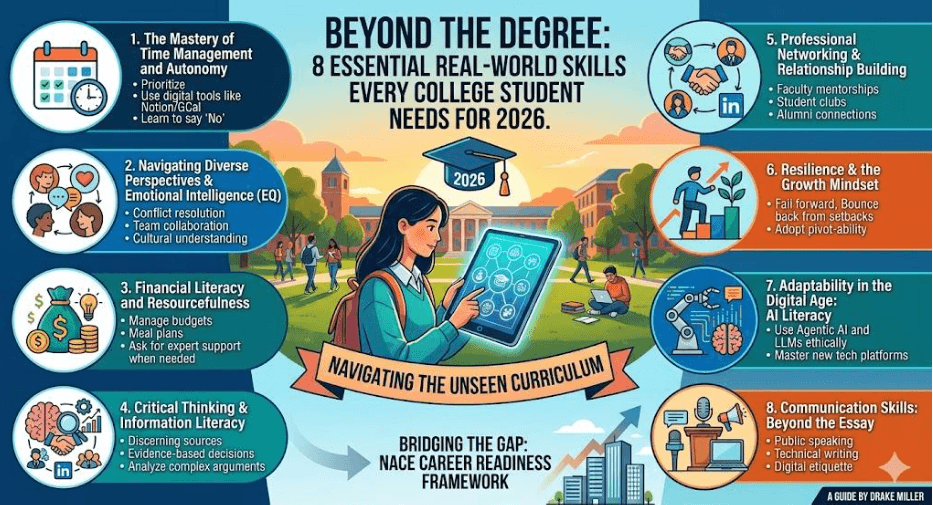
1. The Mastery of Time Management and Autonomy
In high school, your schedule is largely curated by parents and teachers. In college, that safety net disappears. You are suddenly responsible for balancing 15+ credit hours, extracurricular commitments, social lives, and perhaps a part-time job.
Learning to prioritize tasks is perhaps the most immediate “real-world” skill gained. In the professional world, managers don’t monitor your hourly progress; they care about results and deadlines. For a college freshman, mastering this in the first semester is the difference between thriving and burnout. College teaches you how to:
- Audit your energy: Deciding whether to study for a chemistry exam at 6 AM or 11 PM based on your personal productivity cycles.
- Use digital tools: Leveraging calendars, Trello boards, or Notion to track long-term projects—skills that translate directly to project management roles.
- The Power of Saying “No”: Understanding that you cannot attend every social event if you want to maintain your GPA and mental health.
2. Navigating Diverse Perspectives and Emotional Intelligence (EQ)
A university campus is often the first time a student is immersed in a truly global community. Sharing a dorm with someone from a different state or continent, or collaborating on a group project with peers from vastly different socioeconomic backgrounds, builds profound Emotional Intelligence.
Conflict resolution is a primary byproduct of this diversity. Whether it’s negotiating “quiet hours” with a roommate or managing a teammate who isn’t pulling their weight in a business seminar, these interactions mirror the office dynamics of Fortune 500 companies. You learn to move past personal biases to achieve a common goal—a skill that is highly prized by recruiters in the USA and beyond. This falls under the “Equity and Inclusion” competency, which is now a baseline requirement for major corporate roles.
3. Financial Literacy and Resourcefulness
For many, college is the first encounter with a “real” budget. Managing a meal plan, paying rent for an off-campus apartment, and accounting for the rising costs of textbooks forces a crash course in financial literacy. You learn the difference between “wants” and “needs” in a way that a high school allowance never taught.
Beyond just money, college teaches resourcefulness. When a student faces a challenging module or a crushing deadline, they must seek out academic support services or utilize an expert essay writing service to understand complex formatting, research standards, and data analysis. Knowing when to ask for help and how to identify reliable resources is a hallmark of a successful professional.
4. Critical Thinking and Information Literacy
We live in an era of information overload. In 2026, the ability to discern a credible source from “fake news,” biased data, or AI-hallucinated facts is a survival skill. Academic research requires students to vet peer-reviewed journals, analyze methodology, and synthesize conflicting viewpoints into a coherent argument.
This level of critical thinking transfers directly to any career—from data analysis to marketing—where you must make evidence-based decisions rather than relying on gut feeling. In the USA market, where data-driven roles are expanding, this “Information Literacy” is often more valuable than the degree subject itself. It allows you to look at a corporate report and ask the right questions rather than accepting the summary at face value.
5. Professional Networking and Relationship Building
They say, “It’s not just what you know, but who you know.” College provides a condensed environment to practice the art of networking before the stakes are tied to a paycheck.
- Faculty Mentorships: Learning how to approach a professor during office hours is great practice for approaching a CEO or Department Head later in life.
- Clubs and Societies: Taking a leadership role in a student organization teaches you how to manage a budget, lead meetings, and recruit members.
- Alumni Networks: Engaging with former students provides a roadmap for career trajectories and opens doors to internships that aren’t advertised on public job boards like LinkedIn or Indeed.
See also: The Impact of Virtual Reality on Education and Training
6. Resilience and the “Growth Mindset”
Not every exam will be an A. Not every internship application will result in an interview. College is a series of small failures that build a thick skin.
Resilience—the ability to bounce back from a poor grade or a rejected paper—is what separates successful entrepreneurs from the rest. By analyzing what went wrong and adjusting your strategy for the next semester, you develop a “growth mindset.” This psychological flexibility is essential in a volatile job market where industries are constantly being disrupted by AI and automation. Employers in 2026 value “pivot-ability” over static knowledge.
7. Adaptability in the Digital Age: AI Literacy
Modern college life is inextricably linked with technology. However, being “digitally fluent” in 2026 goes beyond using Google Docs. Students must now understand Agentic AI and how to use Large Language Models (LLMs) ethically and efficiently.
College doesn’t just teach you how to use one tool; it teaches you how to learn any tool. Whether it’s mastering Learning Management Systems (LMS) like Canvas or using AI-driven tools for data visualization, you are training your brain to adapt to rapid technological shifts. This meta-skill ensures you remain relevant in a tech-driven economy where “upskilling” is a permanent requirement.
8. Communication Skills: Beyond the Essay
While writing 2,000-word essays is a staple of the American college experience, the communication skills developed are much broader:
- Public Speaking: Presenting a slide deck to a room full of peers builds the confidence needed for boardroom pitches.
- Technical Writing: Learning to explain complex ideas clearly and concisely for different audiences.
- Digital Etiquette: Crafting professional emails to faculty and administrators—an underrated skill in a world of Slack and Instant Messaging.
Clear communication reduces errors in the workplace and helps in negotiating salaries, pitching ideas, and leading teams.
Bridging the Gap: The NACE Career Readiness Framework
To understand why these skills matter, we must look at what employers actually want. The National Association of Colleges and Employers (NACE) identifies several core competencies that define a “career-ready” graduate. These aren’t just suggestions; they are the benchmarks used by HR departments across the USA.
| NACE Competency | Collegiate Application | Real-World Value |
| Critical Thinking | Solving complex research problems. | Evidence-based decision making. |
| Communication | Writing reports and public speaking. | Influencing stakeholders & clients. |
| Teamwork | Collaborative group projects. | Effective cross-functional work. |
| Technology | Mastering AI and digital platforms. | Adapting to industrial automation. |
| Leadership | Managing a club or study group. | Directing projects and people. |
| Professionalism | Meeting deadlines and academic integrity. | Building a reliable brand at work. |
| Career & Self-Dev. | Networking and internship hunting. | Continuous lifelong learning. |
| Equity & Inclusion | Engaging with a global campus. | Thriving in a diverse workplace. |
College isn’t just a place to learn facts; it is a four-year simulation of these NACE competencies. When you struggle through a group project with a difficult partner, you aren’t just “doing homework”—you are fulfilling a professional requirement for teamwork and collaboration.
Conclusion: The Holistic ROI of College
The Return on Investment (ROI) of a college degree isn’t just the salary bump associated with a diploma. It is the cumulative effect of four years spent solving problems, meeting deadlines, and interacting with the world as an independent adult.
For high school students looking toward the future, remember that your GPA is only half the story. The “Real-World Skills” you cultivate between the classes—the grit, the networking, and the self-discipline—are the assets that will truly sustain your career for decades to come. As we move further into the age of AI, the human elements of education—EQ, leadership, and critical thought—become your greatest competitive advantage.
Frequently Asked Questions
Q.1 Can I build these skills without going to college?
Yes, through military service, trade schools, or starting a business. However, college provides a structured, “low-risk” environment to fail and learn before entering the high-stakes professional world.
Q.2 How do I show these “soft skills” on a resume?
Don’t just list “Time Management.” Instead, write: “Balanced a 15-credit course load while managing a 20-hour-per-week internship and leading the Debate Club.” Use specific examples of your collegiate experience to prove the skill.
Q.3 What is the most important skill for a freshman to learn?
Adaptability. The transition from high school to college is a major life shift. Being able to adjust your study habits and social expectations quickly will determine your success in the first semester.
Q.4 How does AI change the value of these skills?
AI can write code or summarize text, but it cannot navigate a difficult interpersonal conflict or build a mentorship. As AI handles more technical tasks, these “human” real-world skills become your greatest competitive advantage in the 2026 job market.
About the Author
Drake Miller is a senior content manager and academic strategy consultant with over a decade of experience in the higher education sector. Based in the USA, Drake specializes in bridging the gap between academic theory and professional practice. He is a passionate advocate for AI literacy in education and focuses on helping students navigate the complexities of the modern global workforce.